A $20 LED Bulb Swap Pays for Itself in 4.5 Months
Running 20 incandescent bulbs costs roughly $5.50/month in electricity and replacements. The same light from LEDs? About $1.10/month. That's a payoff so fast you'll forget you even spent the money.
Payoff Time
4.5 mo
LED Bulbs vs Incandescent Bulbs
Product cost
$20
one-time
Annual savings
$53
vs Incandescent Bulbs
Best Payoff
LED Bulbs
The Setup: You're Literally Burning Money
Here's something fun: a classic 60-watt incandescent bulb converts about 90% of its energy into heat, not light. You're essentially running 20 tiny space heaters on your ceiling. Meanwhile, LED equivalents produce the same brightness at 9 watts — roughly 85% less electricity — and they don't burn out every few months like some kind of planned-obsolescence art project.
Most people vaguely know LEDs are "better," but they see a pack of incandescents for a dollar and a pack of LEDs for a few bucks more and think, "eh, not worth the hassle." That math instinct is wrong, and we can prove it with a napkin and about 30 seconds.
The Math
We modeled a typical US household swapping out 20 bulbs, each used about 3 hours per day, at the 2026 national average electricity rate of $0.16/kWh. Incandescent 60W bulbs cost roughly $1 each but only last ~1,000 hours — so you're replacing them constantly. LED 9W equivalents last 15,000+ hours, which means years of zero replacement cost. The upfront investment for 20 LEDs is around $20.
Your old bulbs cost you about $5.50/month between electricity and replacements. LEDs drop that to roughly $1.10/month. That's a savings of about $4 every month, which means your $20 investment pays for itself in just 4.5 months — and then keeps saving you approximately $53 per year, every year, for as long as the bulbs last (which is a very long time).
| Led bulbs | incandescent lights | |
|---|---|---|
| Upfront cost | $20 | $0 |
| Monthly ongoing | $1 | $6 |
| Month 1 total | $21 | $6 |
| Month 2 total | $22 | $11 |
| Month 3 total | $23 | $17 |
| Month 4 total | $24 | $22 |
| Year 1 total | $33 | $66 |
| Year 3 total | $60 | $198 |
| 5-year total | $86 | $330 |
* All figures are estimates. See methodology for assumptions.
Cumulative Cost Over Time
The lines cross at the breakeven point — that's when the savings zone begins.
When This Does NOT Pay Off
Let's be honest: if you only have a couple of lamps you use for 30 minutes a day, the savings shrink to almost nothing and the payoff stretches out to the point where you genuinely might not care. The math above assumes 20 bulbs at 3 hours daily — a fairly average household. If your usage is well below that, the annual savings might land closer to $26 instead of $53. Still positive, but not exactly life-changing money.
There's also the edge case of specialty bulbs. If you need specific shapes, color temperatures, or dimmable fixtures, the LED version can cost meaningfully more than the generic A19 packs we priced here. Smart bulbs, vintage Edison-style LEDs, and candelabra bases can run $5–$10 per bulb, which pushes the payoff timeline out further.
Finally, if you're renting and your landlord provides bulbs (rare, but it happens), or if you're moving soon and can't take the bulbs with you, the calculus changes. But for the vast majority of people in the vast majority of situations, this is one of the most obvious upgrades in all of personal finance. It's not exciting. It's not sexy. It just quietly saves you money every single month.
Sensitivity Analysis: Your Results May Vary
Payoff time changes based on how much you currently spend.
Heavy use (6+ hrs/day)
Work from home, lights on all evening, or a larger home — savings jump to $9/month and payoff comes in just 2.3 months.
2.3mo
$106/yr
Typical use (3 hrs/day) (our base case)
Average US household with 20 bulbs running about 3 hours daily — the sweet spot at $4/month in savings.
4.5mo
$53/yr
Light use (1.5 hrs/day)
You're out most of the day or only use a handful of lights — savings are real but modest at $2/month.
9.1mo
$26/yr
"A $20 pack of LED bulbs pays for itself in 4.5 months, then saves you $53 every year — and you'll basically never change a bulb again."
What We Recommend
Below are three solid LED bulb packs at different price points. All pricing assumes you're outfitting roughly 20 bulbs (so you may need two packs for the smaller bundles). Our payoff math is based on a ~$20 upfront cost, 20 bulbs at 3 hours/day, and $0.16/kWh electricity — adjust your expectations if your setup looks different.

Feit Electric A19 LED Light Bulb, 60W Replacement, Dimmable, Selectable Color Temperatures (2700K-5000K), 800 Lumens, General Purpose Light Bulbs, 15,000-Hour Lifetime, OM60DM/5CCTCA/LED/ 10 Pack
$24
upfront
5.4mo
payoff
$53
/ year
The Feit Electric 10-pack is the budget king here. At $17, you get dimmable bulbs with selectable color temperature (2700K–5000K), which is genuinely rare at this price. You'll need two packs for a full 20-bulb swap, but even at $34 total you're still looking at a fast payoff. The 15,000-hour lifetime matches pricier competitors.
Check current price →Price shown is approximate. Click for current price. Affiliate link.
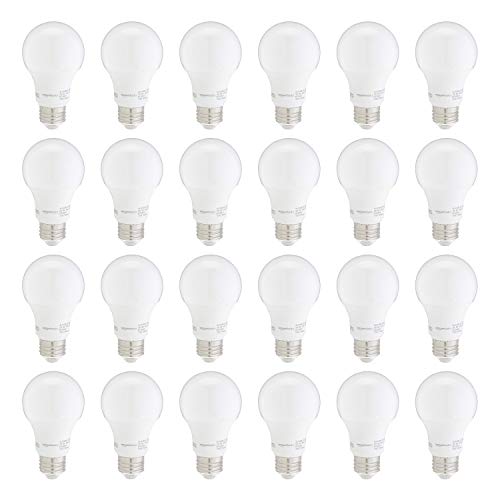
Amazon Basics A19 LED Light Bulbs, 60W Equivalent, Daylight White 5000K, Non-Dimmable, Energy Efficient 9W, E26 Base, 10,000 Hour Lifetime, 24-Pack
$16
upfront
3.7mo
payoff
$53
/ year
The Amazon Basics 24-pack is the value sweet spot — $20 gets you more bulbs than you need, and the 10,000-hour rated lifetime still translates to roughly 9 years at 3 hours/day. They're not dimmable and locked to 5000K daylight, so they're best for kitchens, garages, and anywhere you want bright, clean light without fuss.
Check current price →Price shown is approximate. Click for current price. Affiliate link.

DEGNJU LED Light Bulbs, 100 Watt Equivalent LED Bulbs A19, 5000K Daylight Light Bulb, 1500 Lumens, E26 Standard Base, Non-Dimmable, 13W Bright White LED Bulbs for Bedroom Home Office, 12 Pack
$20
upfront
4.6mo
payoff
$53
/ year
The DEGNJU 12-pack steps up to 100W-equivalent brightness (1500 lumens) at 13 watts per bulb, making them ideal for rooms where you want serious light output — home offices, workshops, living rooms. At $21 for 12, the per-bulb cost is a touch higher, but you're getting noticeably more light per watt, which is the whole point of upgrading.
Check current price →Price shown is approximate. Click for current price. Affiliate link.
What we didn't account for
- → Electricity rates vary widely We used $0.16/kWh, the 2026 US national average. If you're in Louisiana at $0.10/kWh, savings shrink. If you're in California or Connecticut at $0.25+/kWh, your payoff is even faster.
- → Usage hours are estimated We assumed 3 hours per bulb per day across 20 bulbs. Your actual usage could be higher or lower depending on your schedule, remote-work habits, and how many lights you leave on "by accident."
- → Replacement costs are approximate We estimated incandescent bulbs at ~$1 each lasting ~1,000 hours. Actual prices and lifespans vary by brand. Cheap bulbs may burn out faster; name brands may last a bit longer.
- → LED lifespan isn't guaranteed Manufacturers rate LEDs at 15,000–25,000 hours, but heat, voltage fluctuations, and enclosed fixtures can shorten that. Real-world lifespan is usually excellent, but it's not literally forever.
See how LED Bulbs compares to other home products.
Home Rankings →