A $30 Electric Kettle Pays for Itself in 20 Months
Boiling water on the stove wastes 2–3x more energy than an electric kettle — that's roughly $2/month trickling down the drain. It's not headline-grabbing money, but it's the kind of savings that just silently runs in the background forever.
Payoff Time
20 mo
Electric Kettle vs Stovetop Boiling
Product cost
$30
one-time
Annual savings
$18
vs Stovetop Boiling

Best Payoff
Electric Kettle
The Setup: You're Overpaying to Boil Water
Think about how many times a day you boil water. Morning coffee. Afternoon tea. Oatmeal. Ramen. A pour-over on the weekend when you're pretending to be fancy. For most households, it's at least once or twice a day — and a lot of that boiling happens on a stovetop that was basically designed to heat the air around the pot as much as the water inside it.
An electric kettle fixes this in the most boring, effective way possible: it wraps a heating element directly around the water. No open flame. No radiant heat escaping into your kitchen. No waiting six minutes while you forget you turned the burner on. It's faster, it's more efficient, and it auto-shuts off so you can't accidentally leave it running — which, if you've ever boiled a pot dry, you know is a real thing.
The Math
We based this on boiling roughly 1.5 liters of water per day — that's about 6 cups, or enough for a couple of coffees and a tea or two. An electric kettle uses around 0.1 kWh per boil at the national average of ~$0.16/kWh. A stovetop uses 2–3x more energy for the same job because of heat loss through the burner, the sides of the pot, and the air around it. That difference works out to about $2/month in energy savings.
At that rate, a $30 electric kettle breaks even in 20 months and then saves you roughly $18 per year going forward. That's not "quit your job" money — but the kettle also lasts 5–7 years on average, which means you're looking at $70–$100+ in total savings over its lifetime from a single $30 purchase. And we haven't even tried to put a dollar figure on the time you save (it's significant — a kettle boils water in about half the time).
| Electric Kettle | Stovetop boiling energy (and time) | |
|---|---|---|
| Upfront cost | $30 | $0 |
| Monthly ongoing | $1 | $2 |
| Month 1 total | $31 | $2 |
| Month 2 total | $31 | $4 |
| Month 3 total | $32 | $6 |
| Month 4 total | $32 | $8 |
| Year 1 total | $36 | $24 |
| Year 3 total | $48 | $72 |
| 5-year total | $60 | $120 |
* All figures are estimates. See methodology for assumptions.
Cumulative Cost Over Time
The lines cross at the breakeven point — that's when the savings zone begins.
When This Does NOT Pay Off
Let's be honest: if you only boil water a few times a week — say, the occasional cup of tea on a Sunday — your savings drop to maybe $1/month or less, and breakeven stretches past three years. At that point, the financial case is thin. You might still want a kettle for the speed and convenience, but you shouldn't pretend it's a money move.
Also, if you're on a gas stove with cheap natural gas rates, the energy gap between stovetop and electric kettle narrows. Gas is already more efficient at transferring heat than an electric coil range, so the savings depend partly on what kind of stove you have and what you're paying per kWh (or per therm). In states with very high electricity rates, the kettle actually wins even bigger; in areas with dirt-cheap gas, less so.
Finally, the premium end of electric kettles — gooseneck models with temperature presets — can run $60–$80+. At that price point, breakeven pushes past three years even at heavy usage. Those kettles are great tools (especially for pour-over coffee), but buy them because you want the features, not because the payoff math is thrilling.
Sensitivity Analysis: Your Results May Vary
Payoff time changes based on how much you currently spend.
Heavy use (3+ boils/day)
You're a tea-and-coffee household that boils water constantly — savings hit $3/month with an 11-month breakeven.
11.1mo
$32/yr
Daily use (1–2 boils/day) (our base case)
The typical household pace — boiling water for coffee, tea, or cooking daily saves about $2/month and breaks even in 20 months.
20mo
$18/yr
Light use (1–2 boils/week)
You're an occasional tea drinker — savings are real but modest at $1/month, with a 40-month breakeven.
40mo
$9/yr
"A $30 electric kettle saves ~$2/month over stovetop boiling and pays for itself in 20 months — then keeps saving $18/year for as long as it runs."
What We Recommend
Here are three electric kettles at different price points, all solid picks. Our payoff math assumes a ~$30 purchase price, so the budget and value options track closest to the numbers above — the premium pick is for the pour-over nerds who want precision and are okay with a longer breakeven.
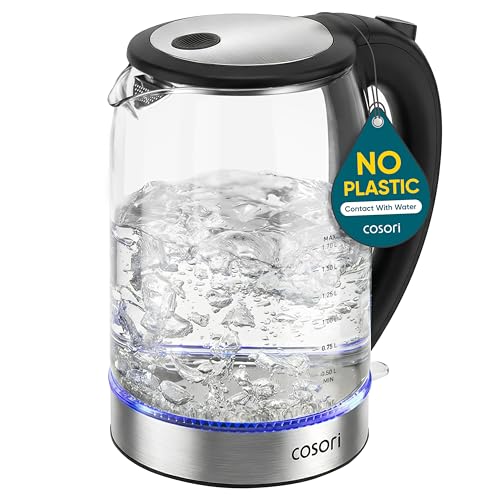
Cosori Electric Kettle, No Plastic Contact With Water, Wide Mouth For Easy Cleaning, Auto Shut Off, 1.7L Tea Kettle & Hot Water Boiler, Water Heater & Teapot, Borosilicate Glass, Black, 1500W
$26
upfront
17.3mo
payoff
$18
/ year
The Cosori Glass Kettle is the best budget pick because it does exactly what you need — boils water fast, shuts off automatically, and keeps plastic away from your water — for about $25. The wide-mouth design makes it easy to clean and fill, and at this price point you hit breakeven even faster than our baseline math assumes. No bells and whistles, just efficient boiling.
Check current price →Price shown is approximate. Click for current price. Affiliate link.
Chefman Electric Kettle with Temperature Control, 5 Presets LED Indicator Lights, Removable Tea Infuser, Glass Tea Kettle & Hot Water Boiler, 360° Swivel Base, BPA Free, Stainless Steel, 1.8 Liters
$30
upfront
20mo
payoff
$18
/ year
The Chefman is the sweet spot. For $30 you get five temperature presets (great if you drink green tea or want water just below boiling), LED indicators, a built-in tea infuser, and a 1.8-liter capacity that's the biggest of the three. It matches our baseline payoff math almost exactly, and the temperature control means you're not wasting energy over-boiling when you don't need to.
Check current price →Price shown is approximate. Click for current price. Affiliate link.

COSORI Electric Gooseneck Kettle with 5 Temperature Control Presets, Pour Over Kettle for Coffee & Tea, Hot Water Boiler, 100% Stainless Steel Inner Lid & Bottom, 1200W/0.8L
$70
upfront
46.7mo
payoff
$18
/ year
The Cosori Gooseneck is a pour-over coffee kettle that happens to also be an excellent general-purpose kettle. The 5-preset temperature control and precision spout give you barista-level water flow, but at $65 it more than doubles the breakeven time to about 3 years. Buy this one because you love the craft of a good pour-over — the energy savings are a nice bonus, not the main event.
Check current price →Price shown is approximate. Click for current price. Affiliate link.
What we didn't account for
- → Time savings not included An electric kettle boils water roughly twice as fast as a stovetop. That's real value — especially over thousands of boils — but we didn't try to assign a dollar amount to your time.
- → Energy rates vary widely We used the U.S. national average of ~$0.16/kWh. If your electricity costs more, your savings are higher; if you're on cheap natural gas, the gap shrinks.
- → Stovetop type matters Gas, electric coil, and induction stovetops all have different efficiency levels. Our 2–3x energy multiplier is a reasonable average, but your actual mileage may differ depending on your setup.
- → Kettle lifespan assumed We assumed the kettle lasts at least 3–5 years with daily use. If yours dies early due to hard water buildup or a cheap heating element, the total lifetime savings shrink accordingly.
See how Electric Kettle compares to other kitchen products.
Kitchen Rankings →