A $70 Compost Bin Pays for Itself in Under 6 Months
Between bagged fertilizer and extra trash bags for food scraps, the average household quietly spends about $12/month on stuff that a compost bin replaces for free. That's $144/year back in your pocket — and your tomatoes will be annoyingly smug about it.
Payoff Time
5.8 mo
Compost Bin vs Store-Bought Fertilizer & Trash Bags
Product cost
$70
one-time
Annual savings
$144
vs Store-Bought Fertilizer & Trash Bags
Best Payoff
Compost Bin
The Setup: Your Banana Peels Are Costing You Twice
Here's the thing nobody thinks about: you're already paying to throw away the exact stuff your garden needs. Food scraps and yard waste go into trash bags you buy, get hauled off by a service you pay for, and then you turn around and buy bagged fertilizer and soil amendments to feed your plants. You're literally paying on both ends of the same transaction.
A compost bin short-circuits the whole loop. Kitchen scraps, coffee grounds, eggshells, yard trimmings — they all go in the tumbler instead of the trash. A few weeks later, you've got rich, dark compost that replaces the bags of fertilizer and soil conditioner you'd normally grab at the hardware store. No ongoing cost. No subscription. Just gravity and decomposition doing their thing.
The Math
We assumed a typical household spends roughly $8/month on bagged fertilizer and soil amendments, plus about $4/month on extra trash bags for food scraps and yard waste. That's $12/month in recurring costs that a compost bin eliminates entirely. The bin itself runs on kitchen scraps and yard waste you're already producing — so its ongoing cost is genuinely $0.
At a purchase price of $70 and savings of $12/month, the bin pays for itself in 5.8 months. After that, you're pocketing $144 per year. Leave it running for three years and that's $432 in savings from a single plastic tumbler sitting in your backyard.
| Compost Bin | Store-Bought Fertilizer & Trash Bags | |
|---|---|---|
| Upfront cost | $70 | $0 |
| Monthly ongoing | $0 | $12 |
| Month 1 total | $70 | $12 |
| Month 2 total | $70 | $24 |
| Month 3 total | $70 | $36 |
| Month 4 total | $70 | $48 |
| Year 1 total | $70 | $144 |
| Year 3 total | $70 | $432 |
| 5-year total | $70 | $720 |
* All figures are estimates. See methodology for assumptions.
Cumulative Cost Over Time
The lines cross at the breakeven point — that's when the savings zone begins.
When Composting Does NOT Pay Off
Let's be honest: composting isn't magic, and it isn't for everyone. If you live in a small apartment with no outdoor space, a tumbling compost bin is a non-starter — you'd need a countertop vermicomposting setup, which is a different (wormier) calculation. Similarly, if you don't garden at all and never buy fertilizer or soil amendments, half of the savings equation disappears. You'd still save on trash bags, but the breakeven stretches out significantly.
Climate matters, too. In colder regions, composting slows to a crawl during winter months, meaning you won't produce usable compost year-round. You'll still divert waste from the trash, but the fertilizer-replacement savings are seasonal. And if you're the kind of person who buys premium organic fertilizer blends, your actual savings could be higher than our estimate — but if you've been getting by with whatever's cheapest at the dollar store, they could be lower.
Finally, there's a small time cost. You need to turn the tumbler every few days and manage the green-to-brown ratio. It's not hard — maybe 5 minutes a few times a week — but it's not completely zero-effort either. If you know you'll abandon it after a month, save your $70.
Sensitivity Analysis: Your Results May Vary
Payoff time changes based on how much you currently spend.
Avid gardener ($20/mo saved)
You garden heavily, buy premium soil amendments regularly, and divert significant food and yard waste from the trash.
3.5mo
$240/yr
Typical household ($12/mo saved) (our base case)
You maintain a garden, buy bagged fertilizer a few times a season, and regularly toss food scraps and yard waste.
5.8mo
$144/yr
Light gardener ($7/mo saved)
You buy minimal fertilizer and produce less food waste — savings are modest but the bin still pays off within a year.
10mo
$84/yr
"A $70 compost bin pays for itself in 5.8 months and saves $144 a year — by turning your kitchen scraps into the fertilizer you were already buying."
What We Recommend
We picked three compost tumblers at different price points, all dual-chamber designs that let you cure one batch while filling the next. Our payoff math assumes the $70 mid-range bin — if you grab the budget pick, your breakeven drops to under 5 months.

VEVOR Compost Bin, 43-Gal Dual Chamber Composting Tumbler, Large Tumbling Rotating Composter with 2 Sliding Doors and Steel Frame, BPA Free Composter Bin Tumbler for Garden, Kitchen, Yard, Outdoor
$58
upfront
4.8mo
payoff
$144
/ year
The VEVOR dual-chamber tumbler gets you the same 43-gallon capacity and steel frame as pricier options for about $58. It's no-frills — the sliding doors can be a bit fiddly — but it does the job. At this price, your breakeven drops to under 5 months, making it the fastest payoff of the three.
Check current price →Price shown is approximate. Click for current price. Affiliate link.
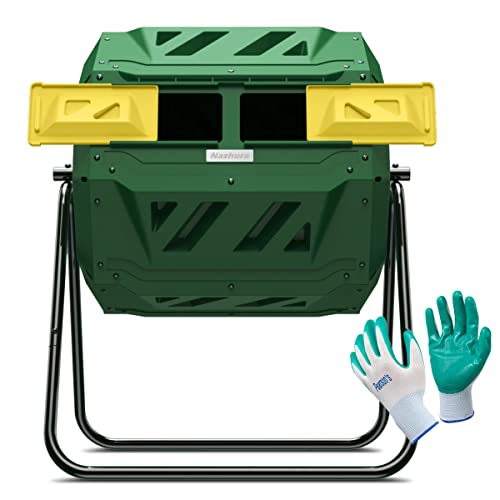
Compost Tumbler Bin Composter Dual Chamber 43 Gallon (Bundled with Pearson's Gardening Gloves)
$70
upfront
5.8mo
payoff
$144
/ year
This 43-gallon dual-chamber tumbler comes bundled with gardening gloves, which is a nice touch since you'll be handling compost regularly. At $70 it's our baseline for the payoff math — 5.8 months to breakeven — and hits the sweet spot between build quality and price.
Check current price →Price shown is approximate. Click for current price. Affiliate link.

Compost Tumbler, Easy Assemble & Efficient Outdoor Compost Bin, 45 Gallon/170 Liter Large Dual Chamber Rotating Composter for Garden, Kitchen, and Yard Waste, Orange Door
$120
upfront
10mo
payoff
$144
/ year
At $100, the premium pick gets you a 45-gallon capacity, a sturdier build, and easier-to-use doors (the orange door design is genuinely easier to latch one-handed). The breakeven stretches to about 8.3 months, but if you plan to compost for years, the better construction is worth the extra $30.
Check current price →Price shown is approximate. Click for current price. Affiliate link.
What we didn't account for
- → Fertilizer costs vary widely Our $8/month fertilizer estimate assumes basic bagged garden soil and granular fertilizer from a big-box store. If you use cheaper products or buy in bulk seasonally, your actual savings will be lower.
- → Compost isn't instant A tumbling composter takes 4–8 weeks to produce usable compost, depending on climate, what you add, and how often you turn it. Your savings don't truly begin until your first batch is ready.
- → Trash bag savings depend on volume We estimated $4/month in trash bag savings, assuming food scraps and yard waste account for roughly one extra bag per week. If your municipality charges per bag or by weight, savings could be higher — or lower if you already use minimal bags.
- → Doesn't replace all fertilizer Compost is a fantastic soil amendment, but it may not fully replace specialized fertilizers (e.g., high-phosphorus bloom boosters). Some gardeners still supplement, which reduces the net savings.
See how Compost Bin compares to other outdoor products.
Outdoor Rankings →