A $15 Menstrual Cup Pays for Itself in 2 Months
The average person spends about $8/month on disposable pads and tampons. A reusable menstrual cup brings that down to roughly $0.50/month for wash and upkeep. Two cycles and you're in the green — then it just keeps saving.
Payoff Time
2 mo
Menstrual Cup vs Disposable Products
Product cost
$15
one-time
Annual savings
$90
vs Disposable Products

Best Payoff
Menstrual Cup
The Setup: The Quiet Subscription You Never Signed Up For
Nobody thinks of pads and tampons as a subscription service, but that's exactly what they are. Every month, another box off the shelf, another $8-ish out of your wallet. It doesn't sting the way a big purchase does — it's more of a slow, steady drip (pun… semi-intended). Over a year that's roughly $96. Over a decade? Nearly a thousand dollars, tossed in the trash. Literally.
A menstrual cup flips that script. You buy one medical-grade silicone cup for around $15, learn a short adjustment curve, and then reuse it cycle after cycle for up to 10 years. Your only ongoing cost is a little cup wash or sterilizing tablets — about $0.50 a month. That's it. No midnight pharmacy runs, no "is my bag stocked?" anxiety.
The Math
We're comparing average US spending on disposable period products (~$8/month, or ~$96/year) against the cost of owning a menstrual cup (~$15 upfront plus ~$0.50/month in maintenance). That nets you about $7.50 in savings every single month. In just 2 months, the cup has paid for itself. After a full year, you're up roughly $90. Keep the same cup for its full lifespan and the savings climb toward $900 — from one $15 purchase.
Even if you grab the premium option at $22, you still break even before your third cycle is over. The math here is less "should I?" and more "why didn't I do this sooner?"
| Menstrual cup | disposable products | |
|---|---|---|
| Upfront cost | $15 | $0 |
| Monthly ongoing | $1 | $8 |
| Month 1 total | $16 | $8 |
| ★ Breakeven (~2 months) | $16 | $16 |
| Month 3 total | $17 | $24 |
| Year 1 total | $21 | $96 |
| Year 3 total | $33 | $288 |
| 5-year total | $45 | $480 |
* All figures are estimates. See methodology for assumptions.
Cumulative Cost Over Time
The lines cross at the breakeven point — that's when the savings zone begins.
When It Doesn't Pay Off
Let's be honest: a menstrual cup isn't for everyone, and the savings only matter if you actually use it. There's a real learning curve — most people need 2–3 cycles to get comfortable with insertion and removal, and some people never love it. If the cup ends up in a drawer after one try, you've spent $15 on a paperweight, not a money-saver. Certain medical conditions (like a prolapsed uterus or an IUD) may also make cup use impractical or inadvisable without a doctor's input.
The math also assumes you fully replace disposables. In practice, many new cup users keep a stash of backup pads or liners for the first few months — or permanently for overnight peace of mind. That chips into the $90/year figure. If you're only replacing half your disposable spending, your annual savings drop closer to $42–$50, which is still solid but not the headline number.
Finally, if you already use a very budget-friendly brand of disposables or get products through assistance programs at little to no cost, the gap narrows significantly. The cup's payoff story is strongest for people currently buying name-brand tampons and pads at retail prices month after month.
Sensitivity Analysis: Your Results May Vary
Payoff time changes based on how much you currently spend.
Heavy use (premium products)
You use premium disposables or have a heavier flow pushing spending to ~$12.50/month, breaking even in just over a month and saving $147/year.
1.2mo
$147/yr
Average use (typical spending) (our base case)
You spend the US average of ~$8/month on name-brand pads or tampons, breaking even in 2 months and saving $90/year.
2mo
$90/yr
Light use (budget disposables)
You spend less on disposables — maybe budget brands or a lighter flow — saving about $5/month and breaking even in ~3 months.
3.2mo
$57/yr
"A $15 menstrual cup pays for itself in 2 months, then saves about $90 every year after that."
What We Recommend
Below are three menstrual cup picks at different price points. All three use medical-grade silicone, come in multiple sizes, and will break even against disposables in 3 months or less — assuming the $8/month average spending on pads and tampons we used in our math above.
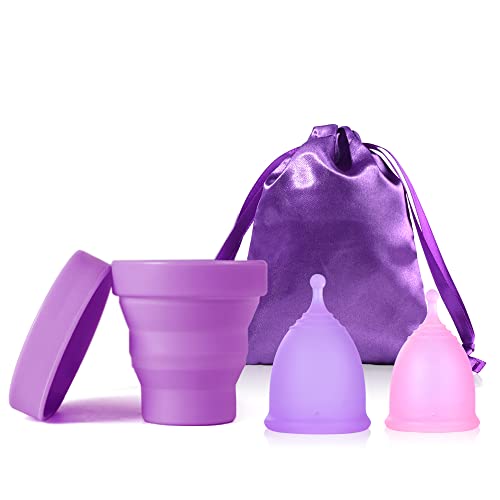
Ginalaia Menstrual Cups with Collapsible Storage Cup, Leak-Proof Design with Medical Grade Silicone Period Cups Reusable, Tampon and Pad Alternative,for Light Flow and Heavy Flow Large+Small
$10
upfront
1.3mo
payoff
$90
/ year
The Ginalaia set gets you two cups (small and large) plus a collapsible storage cup for just $10 — less than many single boxes of tampons. It's a low-risk way to try cup life, and if it clicks, you'll break even against disposables before you even finish your second cycle.
Check current price →Price shown is approximate. Click for current price. Affiliate link.
EcoBlossom Reusable Menstrual Cup Set - The Most Reliable Medical Grade Silicone Period Cups - Comfortably use for 12 Hours (Small & Large)
$16
upfront
2.1mo
payoff
$90
/ year
The EcoBlossom two-cup set hits the sweet spot at $15: well-reviewed medical-grade silicone, a small and large size to match your flow, and a comfortable 12-hour wear time. This is the price point we used in our base math — 2-month breakeven, $90/year in savings. Hard to argue with.
Check current price →Price shown is approximate. Click for current price. Affiliate link.

Viv for Your V Large Premium Menstrual Cups for Heavy Flow, Pull Tab Ring Stem Easy Removal, Soft Tampon Alternative, Comfortable 12 Hour Wear, Medical-Grade Silicone Reusable Period Cup
$22
upfront
2.9mo
payoff
$90
/ year
The Viv cup is purpose-built for heavy flow days, with a pull-tab ring stem that makes removal noticeably easier — a real perk during the learning curve. At $22, it's the priciest option here but still breaks even in under 3 months. If comfort and ease-of-use matter most to you, the small premium is worth it.
Check current price →Price shown is approximate. Click for current price. Affiliate link.
What we didn't account for
- → Learning curve is real Most people need 2–3 cycles to get comfortable with a menstrual cup. Our math assumes full adoption from month one, so your actual breakeven may shift by a cycle or two.
- → Backup products add cost Many cup users still keep disposable liners or pads on hand, especially early on. Any ongoing disposable spending reduces the $90/year savings figure.
- → Your flow may vary We used the average US spend of ~$8/month on disposable products. If your flow is lighter (or you buy budget brands), your baseline cost is lower and savings shrink accordingly.
- → Cup lifespan isn't guaranteed Manufacturers say 5–10 years, but actual lifespan depends on care, storage, and silicone quality. Replacing a cup every 3–5 years still saves money, just less per year.
See how Menstrual Cup compares to other personal-care products.
Personal-care Rankings →